

PAST EXHIBITION
Books Are Burning: Rubén Torres Llorca
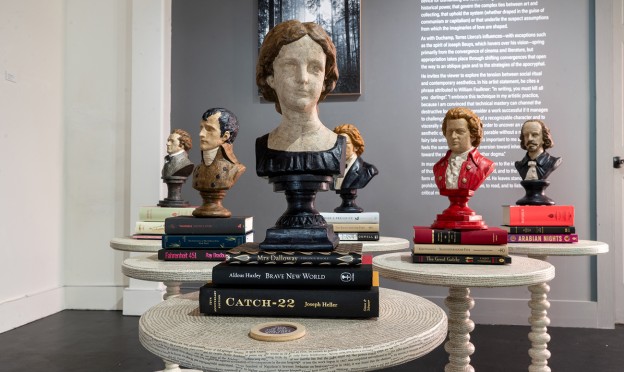
Aluna Art Foundation welcomes Rubén Torres Llorca—one of the pioneers of contemporary Cuban art in the 1980s— for its first solo exhibition at the Tower Art Space in Little Havana. Torres Llorca’s entire body of work turns each element into a device for dismantling the rules of the game: those that uphold historical power, that govern the complex ties between art and collecting, that uphold the system (whether draped in the guise of communism or capitalism) or that underlie the suspect assumptions, at once intimate and collective, from which the imaginaries of love are shaped.
AAF asked him to assemble, quite literally, a personal exhibition, weaving together the themes to which he returns time and time again. The resulting collection, Books are Burning, is a continuation of his larger body of work. As with Duchamp, Torres Llorca’s influences—with exceptions such as the spirit of Joseph Beuys, which hovers over his vision—spring primarily from the convergence of cinema and literature, although his act of plundering these sources never takes place through direct quotation or overt association, but rather through convergences that shift and allow for oblique interpretations and of the strategies of the apocryphal.
In his artist statement, he cites a phrase attributed to William Faulkner “In writing, you must kill all your darlings.” “I embrace this technique in my artistic practice because I am convinced that technical mastery can channel the destructive force of irony. I consider a work successful if it manages to challenge the representation of a recognizable character and to viscerally negate the apparent to uncover an underlying aesthetic quality. This produces a parable without a message, or a fairy tale without a moral, which is important to me as an artist who feels the same irreverence and aversion toward inherited dogma as toward the reproduction of any other dogma.”
Much like the film and literature from which he draws inspiration, the collection’s cohesion is the catalyst for dialogue, debate, and negotiation that each piece offers. For Torres Llorca, the viewer is an essential component of the art itself, and each piece invites the viewer to explore the tension between social ritual and contemporary aesthetics.
In many ways, Rubén Torres Llorca’s works open the door to the thought of gardens that fork, never homogenized, and to the upending of any form of censorship in the adult world. He leaves standing only one prohibition: that of refusing to see, to read, and to listen with a critical mind.
This exhibition is made possible through the generous support of the Barlington Group, with our gratitude to El Espacio 23 for the loan of a work included in the show.